Tuesday, January 28, 2014

War of 1812: Patterson Park Edition

From Baltimore Heritage:

In 1814, Patterson Park was the site of Baltimore’s largest defense against a British land invasion during the Battle of Baltimore. This spring, Baltimore Heritage is leading an archaeological survey of the park to dig up more about this history and preserve the battlefield for future generations.
Join us on the evening of January 29 for an introduction to the project featuring a special presentation on the history of Hampstead Hill and Baltimore’s Eastern Defensive line by Baltimore historian Scott Sheads. We want to hear your questions about the history of the War of 1812 in Patterson Park before we go searching for the answers! For nearby residents around the park, this is a good opportunity to share any questions you may have about how the archaeology will affect the park and learn more our plans for getting the community out and involved.


More news about the forthcoming excavations can be found right here.

Tuesday, January 21, 2014

An Unusual Burial at Fort Meigs, Ohio

In his lengthy discussion of this find over at the Ohio Historical Society Archaeology blog, Bill Pickard mentions a phenomenon familiar to most archaeologists: you always find the most interesting and complicated stuff on the last day of fieldwork.

This was the case during an archaeological survey at the site of Fort Meigs' new visitor's center back in 2001. An earthmover stripped the topsoil from the site while archaeologists examined the exposed subsoil for evidence of pits or other features that might have been dug deep into the ground. As the backhoe cleared the last corner of the dig, someone spotted a piece of rusted metal. They thought it might have been a bit of shrapnel from an artillery bomb...but it turned out to be a horseshoe. You find a lot of horseshoes at historical archaeological sites, but they're usually not still attached to the horse.

Photo of the Fort Meigs horse burial, courtesy of Ohiohistory.org
In fact, there were two horses, one likely a large draft horse (nicknamed "Big Horse" by the excavators), the other a smaller, lighter cavalry horse (nicknamed, naturally, "Little Horse"). Initially, the archaeologists were hesitant to make too much of the discovery. Soldiers had horses, and horses died in battles. All those horses had to end up somewhere, right? But the more they thought about it, the more questions they had. The horses are facing each other, their limbs crossed - was this accidental, just the way the animals fell into the burial pit? Or were they deliberately arranged in this face-to-face position, and if so, why? Why were these two animals buried together? And why were they buried at all? Isn't that a lot of effort? Wouldn't cremation be easier?

More details from Bill Pickard's discussion of the burial at Ohiohistory.org:
Aside from the obvious size difference, there were other features that defined the two animals, in particular their shoes. Big Horse was a large, robust animal, possibly even a mule. Its shoes were large, thick items with aggressive calks, well suited for an animal tasked with heavy lifting and pulling. The shoes appeared to be individually forged items as they were slightly different one to the next, made and fitted for this particular animal. There were just three shoes recovered with Big Horse, the two rear shoes and the right front shoe. The left front shoe was missing but nail fragments immediately below that hoof indicates it was removed after the horse was down. Their non-standard design tends to rule out that it was removed as a replacement or a spare for another horse. Little Horse was about three quarters the size of its partner with a much more gracile skeletal structure. A single left rear shoe was recovered with this animal. Unlike the bold nature of the shoes on Big Horse, this shoe was small, thin and almost flat, a shoe likely built for running or speed and not for heavy exertions. Iron nail fragments found adjacent to the right front hoof strongly indicates, as in the case of its larger companion, that the shoe had been removed sometime after Little Horse had been put down. It’s an interesting phenomenon, and after the passage of nearly two hundred years it’s hard to say exactly what the motivation might have been to remove the shoes from the horses.
A further curiosity was uncovered as they began removing the bones from the burial spot: a complete pig's head (but just the head) had been buried along with the horses in the pit. So: two horses, buried together, each having had a single shoe removed, accompanied by the head of a pig. Was this a commonplace disposal of animal remains, or is there something more to it?

These are (according to the Fort Meigs museum) the first horses ever recovered from a War of 1812 archaeological site. There is even a video about their discovery. Can somebody in Ohio please go and watch the video and tell us more?

Friday, January 3, 2014

A Scourge of Mussels

Haunting and fascinating photos over at National Geographic showing photographs of War of 1812 shipwrecks before and after the arrival of invasive quagga mussels. I had no idea mussels ate archaeology! See more over at the Hamilton and Scourge National Historic Site.
Two hundred years ago today, as the United States, Great Britain, and Canada were embroiled in the War of 1812, a sudden storm hit Lake Ontario with a fury. It proved fatal for two of the ships among a U.S. Naval fleet in Sackett's Harbor: the Hamilton and the Scourge.Though nearby vessels managed to save 16 of the crew, at least 53 perished as the ships sank below the waves. The armed schooners came to rest upright and remarkably intact—masts and all—about 1,500 feet (460 meters) apart and 300 feet (90 meters) deep.
The wrecks, discovered in 1973, are the best-preserved examples of their kind, says Parks Canada senior underwater archaeologist Jonathan Moore. Both were originally built as merchant schooners, then modified to serve as warships.
The figurehead on the Hamilton depicts Diana, the Roman goddess of hunting, who was the 67-foot-long (20-meter-long) ship's original namesake when it was built for New York merchant Matthew McNair in 1809. Shortly after the War of 1812 began, the ship was purchased by U.S. Navy Commodore Isaac Chauncey for his fleet on Lake Ontario and renamed in honor of Navy Secretary Paul Hamilton.
—Amanda Fiegl
Photograph by Emory Kristof, National Geographic

Friday, December 20, 2013

Archaeology Takes Back Loser's Day

The town of Essex, Connecticut has something in common with Bladensburg, Maryland: both were invaded by the British in 1814, and neither town came out of the engagement covered in glory.

Late one April night 1814, a British raiding party rowed six miles up the Connecticut River to burn the privateers of Essex, then known as Pettipaug. Within six hours, they had torched 27 ships and taken or destroyed thousands of dollars’ worth of rigging materials and had, according to history, met little to no resistance. The raid resulted in the single greatest loss to American shipping of the entire war.

Detail from the map Connecticut, from actual survey, Hartford, CT: Hudson & Goodwin, 1811 – University of Connecticut Libraries’, Map and Geographic Information Center (MAGIC) -  Via.
You can read a more in-depth account of the attack on Pettipaug/Essex here at ConnecticutHistory.org.

Essex has a sense of humor about the event now known as The Great Attack. Every second Saturday in May, there is a parade down Main Street. It is led by the Sailing Masters of 1812, dressed in period U.S. naval uniforms, and they march to the waterfront at the Connecticut River Museum (site of the British landing), accompanied by fifes and drums, to raise the flag in commemoration of an event now known as "Loser's Day." Maybe now it can be "At Least We Tried" Day?

But now, an archaeological project is bringing new evidence to light - evidence that suggests the British met more resistance at Pettipaug than originally thought. This story about 1812 Archaeology in the news by Eric Hesselberg comes from The Hartford Courant, and was printed September 30, 2013:
OLD SAYBOOK — Archaeologists have found evidence of a shipwreck in the Connecticut River that could be linked to a 200-year-old battle in which the British set fire to 25 ships in Essex harbor, the largest maritime loss of the War of 1812.
The wreck lies in several feet of water off Watrous Point, a mile south of Essex harbor, and is indicated by a "ballast pile," an oblong mound of stones that were once in the ship's hold for stability. The stones remained after the hull disintegrated. 
Under gray skies Friday, archaeologists from the University of Connecticut and the Mashantucket Pequot Research Center stood waist deep in the chilly river water removing hundreds of pounds of the ballast stone to the reach the hull beneath. Waves from passing boats jostled the crews as they struggled to keep their footing. 
Two hours in the water yielded only some fragments of charred wood and a rusty nail, which were bagged for further examination. The team plans to return with a suction dredge in coming days to remove more mud and debris, believed to be covering the ship's timbers. 
"With archaeology, what you don't find can be just as important as what you do find," said UConn archaeologist Kevin McBride, who is leading the project along with battlefield historian Jerry Roberts, former executive director of the Connecticut River Museum. 
Roberts and McBride, who is also Research Director of the Mashantucket Pequot Museum, are working to identify battlefields linked to the Essex Raid, which took place April 8, 1814, two years into the War of 1812. The project is funded by a grant to the Connecticut River Museum in Essex from the Battlefield Protection Program of the National Parks Service. It seeks to have an area on both sides of the Connecticut River between Essex and Saybrook Point designated as a battle site on the National Register of Historic Places. 
Roberts is also writing a book on the subject for Wesleyan University Press, which is due out next spring. 
In Old Saybrook, the researchers are trying to determine whether the wreck is the long-lost privateer, Young Anaconda, which was captured by the British and later sunk. The 300-ton brig had run aground while British marines were attempting to tow her downriver as a prize. It was later set ablaze. 
"This fits the location for our ship really well," said Roberts, adding that if some of the hull can be recovered, construction details can be used to determine whether it was a privateer. "Privateers were built quickly and cheaply, so we should be able to find evidence of that," Roberts said. 
UConn marine archaeologist Kroum Batchvarov, a leading authority on shipwrecks, is assisting with the investigation. 
"My firm belief is that you have a shipwreck with a ballast pile like this," Batchvarov said. "There is a ship here. I don't know where it is, but it's here." 
Digging on a nearby lawn has turned up more than 20 musket balls, fueling speculation that the wreck is the American privateer. "There was some major action here," McBride said. 
Roberts learned of the shipwreck several months ago from the property's owner, Andrew Carr, who spotted the ballast pile years ago while building a dock. A boater, himself, he said the location of the stones made it unlikely that they were anything else by a shipwreck. 
"I heard Jerry talk about the Essex Raid and how the British captured a ship and then burned it right about here, and I thought this just might be the one," Carr said. 
The British Raid on Essex was prompted by the harassing of British ships by American privateers during the War of 1812, some sailing out of Essex, then a center of shipbuilding and trade. Connecticut skippers had turned to privateering to recoup their losses from the British blockade of Long Island Sound. 
In this government-sanctioned piracy, captains were issued "letters of marque," allowing them to seize enemy ships as prizes that were then sold at auction, with the profits divided among ship owners, captain, crew and the government. 
The success of Essex privateers drove the British to respond with a bold attack on the night of April 8, 1814, when 136 Royal Marines stormed ashore and proceeded to set fire to the town's fleet, some vessels still on the stocks being built. 
The traditional view was that Essex, then known as Pettipaug, gave up without a fight, and the town for years has marked the day with a parade and celebration locals refer to as Loser's Day. 
Roberts and McBride are helping to change that view. Both the Americans and the British, they believe, fought valiantly. 
"I'm an historian – I'm about story," Roberts said. "But in order to verify this battle site, you need archaeology. Kevin will tell you that without artifacts you can't prove that a story really happened. So we make a good team."
Check out some photos of the shipwreck exploration over here at the Hartford Courant

Monday, December 9, 2013

The Madisons' Missed Connections

Continued from the last post (Dolley's Difficult Run), Architectural Historian Matt Manning concludes this tour of Dolley & James Madison's travels through Washington, Maryland and Virginia in the aftermath of the British attack on the U.S. capital. 


Wednesday, August 24, 1814

In the morning, James Madison receives a plea from General William Winder, commander of the American forces in defense of Washington, requesting the president’s urgent counsel. Madison first rides to Winder’s camp southeast of the President’s House where he meets with members of his cabinet, including Secretary of State James Monroe, Secretary of the Navy William Jones, Attorney General Richard Rush, Secretary of the Treasury George Campbell, and Secretary of War John Armstrong. From there, Madison continues to Bladensburg to meet with General Winder as British troops approach the town from the southeast. Before departing Washington, he gives instructions to his wife, Dolley, to abandon the President’s House should the imminent battle turn for the worse.

In the intense afternoon heat, Madison watches above Bladensburg as the battle unfolds. He moves back as the fighting intensifies, and turns to retreat when British forces disrupt the American lines and the poorly trained American militia is unable to regroup and turn back the battle-hardened British regulars.

The battle lost and the American army in disarray, Madison makes his way back to Washington. He stops briefly at the President’s House around four o’clock to find his wife has already left for Bellevue. In Washington, Madison is joined by Brigadier General John T. Mason, Richard Rush, and other aides. Madison’s initial plan called for the group to reconvene in Frederick, Maryland, in the event that Washington would fall, but he at some point reconsidered. (Missing from the rendezvous are Armstrong and Campbell, who were apparently not advised of the change in plans; both traveled to Frederick.) Without time to reach Dolley at Bellevue, Madison sends word for the First Lady to meet him at Foxall Foundry; however, when he finds the road crowded with refugees, he again changes plans, calling for the parties to regroup at Wiley’s Tavern in Virginia.

Unable to continue northwest beyond Georgetown, Madison travels to Virginia via Mason’s Ferry, which crosses the Potomac River at present-day Theodore Roosevelt Island.

A map of Mason’s Ferry as it appeared in 1818, just a few years after James Madison’s flight from Washington. The ferry was established by George Mason IV in 1748 when he was granted a charter by the state of Virginia. The ferry, which crossed from Georgetown to the Virginia shore, incorporated the northern tip of a large island Mason’s father had purchased in 1717. In the 1790s, John Mason, who would later travel with James Madison from Washington following the Battle of Bladensburg, constructed a Neoclassical-style summer estate on the island. The estate incorporated landscaped terraces south of the house, planting fields to the north, and an allee of trees along the road between the ferry and the house. The ferry itself included boats or flat-bottomed scows powered at different times by cable or livestock. In 1807, a causeway replaced the boat crossing that originally linked the island with Virginia. The island was occupied by Union Troops during the Civil War and was afterward used for a variety of recreational purposes before it was transformed as a memorial to Theodore Roosevelt in the 1930s. Robert King's 1818 map, courtesy of The C&O Canal Companion, JHU Press
Arriving in Virginia shortly before sunset, Madison confers with his aides about the next appropriate course of action. Accounts of the President’s movements at this stage are few, provided primarily by Paul Jennings, Madison’s teenaged slave, who is left to follow on foot, and by others who later claimed to have seen him at various points along his route.

Madison, seeking information regarding British troop movements and the location of the American forces, travels first to Wren’s Tavern in Falls Church.

Wren’s Tavern is no longer standing, but during the early 1800s, it was an important stopping point for those traveling between Virginia and Washington, D.C. The tavern was constructed by Colonel James Wren (1728-1815), who served in the Revloutionary War. Wren was also the architect of several churches, including Falls Church, for which the City of Falls Church was later named. Thomas Jefferson mentioned the inn in letters to both his daughter and James Madison, calling it a “very decent house” with “respectable people” and suggesting that Madison breakfast there on his route from Washington to Monticello. The tavern functioned as an unofficial headquarters for the Virginia militia during the War of 1812; Colonel Minor, of Minor’s Hill, received his orders at the tavern and reported there with his militia before traveling to the defense of Washington. Photo courtesy of the Historic Marker Database.
After a brief stop, Madison’s entourage continues north, stopping at Minor’s Hill but finding the estate full of other refugees. Perhaps hoping to intercept his wife on her route from Georgetown to Wiley’s Tavern, Madison pushes on to Salona, the home of William and Ann Carter Maffit, friends of the Madisons.

Salona is a Federal-style brick dwelling south of Dolley Madison Boulevard in northeast McLean, Virginia. The house, with a unique T-shaped entrance hall, may have been constructed by Rev. William Moffitt when he purchased the 466-acre tract in 1812. Moffitt was a Presbyterian minister and schoolteacher in Maryland and Virginia. According to legend, Maffitt’s ghost can still be seen riding around Salona on the white horse he frequently used while making pastoral visits to the homes surrounding his farm. During the Civil War, the grounds were occupied by the Union Army as Camp Griffin, and the house served as headquarters for General William “Baldy” Smith. The house still stands today, although residential development has replaced the farmland that formerly surrounded the estate. Photo by Shamus Ian Fatzinger for the Fairfax County Times.
Thursday, August 25

Madison awakes at Salona without news of his wife and unaware that she has just passed the night barely more than a mile away at Rokeby. The President returns to Wren’s Tavern hoping for new information about the status of the capital and the location of British and American forces. At the tavern, he finds Captain George Graham, who provides the President with an armed guard. Madison, perhaps growing desperate for news about Dolley, once more turns toward Salona. Upon arriving back at the Maffitt estate, he discovers he has just missed his wife. William Jones, travelling with the First Lady, has left word that the group has continued to Wiley’s Tavern.

Some reports state that the Madisons had planned to meet at Salona, and not Wiley’s Tavern. This may explain why Madison travels north to Salona and does not continue on a direct route to Wiley’s from Wren’s Tavern and why he later returns to the estate to look for his wife. Although Dolley stops only a mile from Salona, the route from Rokeby may have been judged too dark and crowded to travel any farther.

Following Dolley’s route, but now several hours behind, Madison, Rush, and their armed escort are caught in a violent storm and forced to take shelter at a crossroads. Back in Washington, the same storm reportedly lifts British artillery from the ground and tears roofs from public buildings and residences; even as it extinguishes the fires, the drenching rain fractures the walls of the fledgling capital’s stone buildings.

When the storm abates, the President continues to Wiley’s Tavern, finally arriving around seven o’ clock. Drenched and tired, his reunion with Dolley is fleeting; it is believed that the British have followed Madison into Virginia, and the President leaves sometime after midnight to join the American forces at Montgomery Courthouse in Maryland. 

Friday, August 26th

Madison, now accompanied by Rush, Jones, Mason, and others, travels north to cross the Potomac River at Conn’s Ferry. Upon arriving, they discover the river is swollen from the storm, and the ferryman will not provide passage until the relative safety of morning light. Stuck in Virginia, the party finds shelter nearby and waits for first light.

In the morning, the group crosses the Potomac and continues eight miles to Montgomery Courthouse (present-day Rockville, Maryland). They arrive to discover that General Winder and the American troops have already broken camp and are en route to Baltimore. The presidential party travels eleven more miles but is unable to catch up to Winder before reaching Brookeville, Maryland, late Friday evening.

The residents of Brookeville, a small Quaker community, are opposed to the war, and the President supposedly has trouble finding a place to rest before being taken in by Caleb and Henrietta Bentley. Madison reportedly spends the night at a desk, receiving messages and writing dispatches into the early morning, getting little sleep. 

The Brookeville home of Caleb and Henrietta Bentley as it appears today. The Federal-style Madison House, as it came to be called, was probably constructed between 1798 and 1804 by Caleb Bentley. A wealthy silversmith, merchant, and landowner, Bentley was commissioned in 1793 to create one of the four cornerstones of the U.S. Capitol. He was later appointed by Thomas Jefferson as Brookeville’s first postmaster in 1802. Bentley opened a store the same year, said to be in a wing of the Madison House and to include the post office. Dolley Madison, who was born a Quaker, may have been acquainted with Henrietta Bentley, prompting Madison to seek her out when he arrived in Brookeville. The Bentleys sold the property in 1819, and it was occupied by a long succession of different owners. The house still stands in its original location along Market Street and was the winner of the Washington Post’s Historic Home Contest in October 2012.  Photo courtesy of David O. Stewart

Saturday, August 27th

During the night, Madison receives word that the British have retreated from the capital and it is safe to return to Washington. He writes to James Monroe, who arrives in Brookeville Saturday morning. That afternoon, Madison prepares to travel the 18 miles south back to Washington. Over the last three days, he has travelled approximately 70 miles through stifling heat, a violent storm, and sleepless nights. It is an impressive journey for a 5 ½ foot tall, 63 year old man frequently described as “feeble,” “pale,” or “sickly” throughout his life. With the young nation in disarray, Madison’s greatest challenge was perhaps still ahead.

Friday, November 22, 2013

Dolley's Difficult Run

Today's excellent entry in our ongoing discussion of all things War of 1812 comes from Matt Manning, Architectural Historian at the Maryland State Highway Administration. This essay takes us on an architectural and historical tour of early 19th-century Washington, D.C. and its immediate environs. It also demonstrates that getting out of D.C. has always been a trying endeavor.

In April, we tracked down the hiding place of the now-famous Gilbert Stuart portrait of George Washington after Dolley Madison saved it from the clutches of the invading British. But where did Dolley Madison herself take refuge from the advancing enemy army?

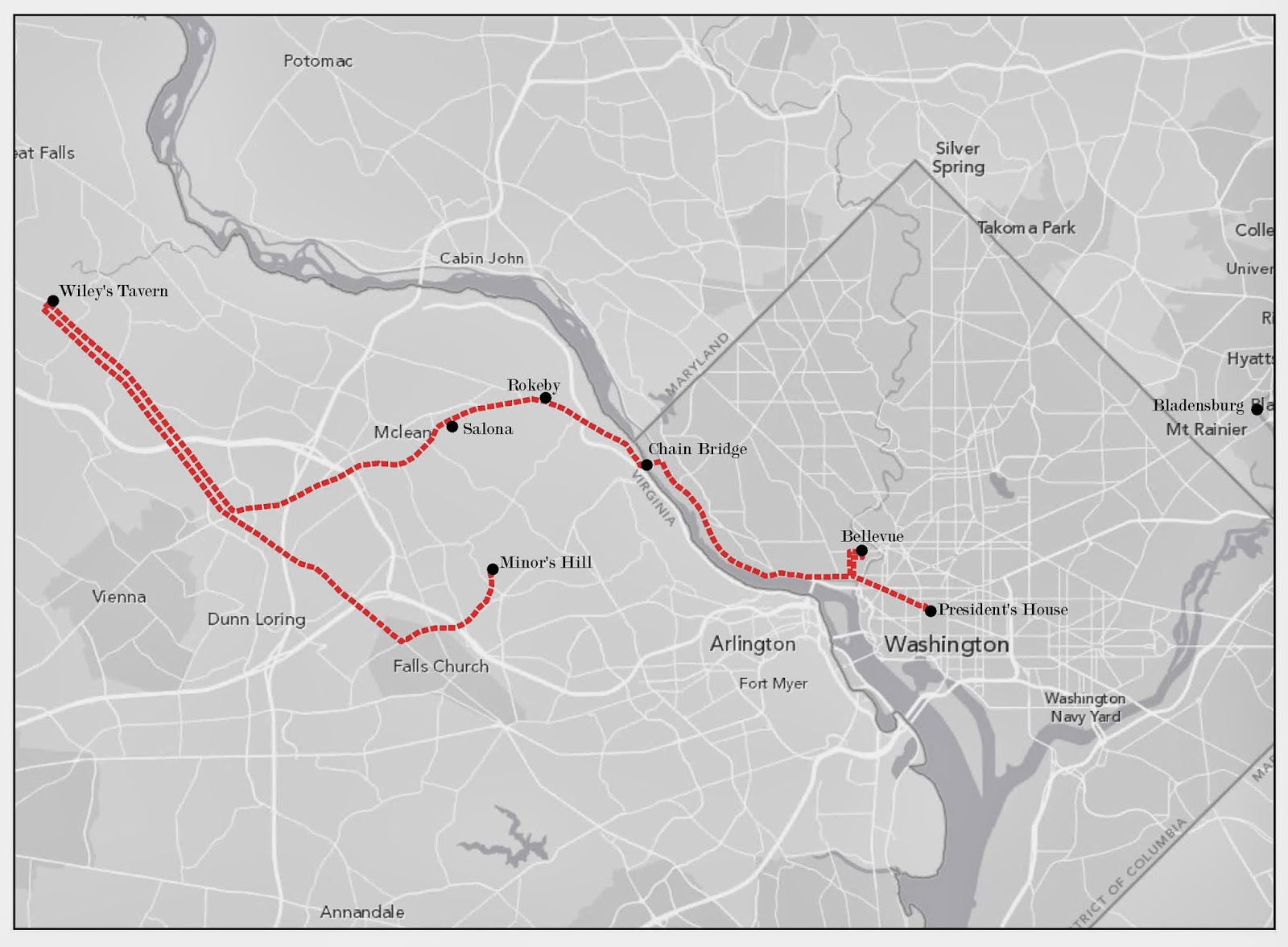
As the Madisons fled Washington, confusion and disorder reigned. This is reflected in the limited and often conflicting accounts of their retreat from the city. The following is an approximation of the First Lady’s travels, based on her own letters, the writings of others involved, and the work of really dedicated researchers who have spent a lot of time sorting through historical documents.

Dolley Madison’s Route from Washington 
Wednesday, August 24, 1814

Sometime after three o’clock, Dolley receives word that the American troops have failed to stop the British at Bladensburg; the First Lady sets to work securing irreplaceable Cabinet papers, George Washington’s portrait, and the crimson velvet curtains at the President’s House. Concerned for Dolley’s safety, Charles Carroll, a friend of the Madisons and a frequent visitor at the President’s House, arrives to retrieve Dolley from her home and hasten her departure. Along with her servant, Sukey, her sister, Anna Payne Cutts, and Anna’s three children, Dolley makes her way to Bellevue, the Georgetown home of Charles and Anne Sprigg Carroll.

Bellevue, located at 2715 Q Street NW in Washington, DC, is a Federal-style brick dwelling with a five-part compound plan. The house was constructed in 1799 by Samuel Jackson, a Philadelphia merchant. Charles Carroll, a cousin of the signer of the Declaration of Independence, purchased the house in 1813, naming it Bellevue. Carroll moved to New York following the War of 1812, and Commodore John Rodgers became one of the house’s first tenants in 1815 before building his own house on Lafayette Square. The Carroll heirs sold the house in 1841. In 1915, the house was moved 100 feet to the north to accommodate an extension of Q Street into Georgetown via the Dumbarton Bridge. The National Society of the Colonial Dames of America purchased and restored the property in 1928; it was renamed and opened to the public as the Dumbarton House in 1932.
At Bellevue, Dolley is joined by US Navy Clerk Edward Duvall and Secretary of the Navy William Jones and his wife. The group soon receives word to meet the President at Foxall Foundry along the Potomac River northwest of Georgetown. Shortly after five o’clock, Dolley sets off with her family and those of Jones and Carroll. En route, the party discovers that James Madison, unable to pass through the throngs of refugees on the roads leading from Washington, has already crossed into Virginia at Mason’s Ferry to the south. Instead, the President suggests the groups reconvene at Wiley’s Tavern in Virginia. 

Dolley and her companions continue northwest out of Georgetown, but travel along the crowded road is slow. Four miles north of Georgetown, the party crosses the Chain Bridge over the Potomac River and into Virginia.

The Chain Bridge as it appeared in 1839. The original bridge was a chain link suspension bridge constructed by the Georgetown-Potomac Bridge Company between 1805 and 1808. It was based on designs by Judge James Finley, an Irish-born engineer responsible for designing and building the first modern suspension bridge in 1801 in Uniontown, Pennsylvania. The Chain Bridge supported a 16-foot wide oak plank roadway that spanned 128.5 feet. The bridge was damaged and repaired numerous times before it was finally replaced by a wood truss bridge in 1852. The location continues to be used as a Potomac River crossing today; it is still known as the Chain Bridge. Image courtesy of Ghosts of DC.
Once in Virginia, Dolley Madison continues northwest. As darkness closes in, she reaches Rokeby Farm, the home of Richard and Matilda Lee Love. The Madisons had often received the Loves in Washington, and Matilda Lee Love was related to James Madison through her stepmother. Only ten miles from the city, Rokeby is brimming with other refugees of Washington. That evening, Dolley watches from a window in Rokeby as fires cast a red glow over the capital. Unbeknownst to her, James Madison passes the night little more than a mile away at Salona, the Virginia estate of Rev. William Maffitt, Jr.

The original house at Rokeby Farm was reportedly constructed in 1813 and would have been the house that sheltered Dolley Madison. However, this building was lost to fire and was rebuilt in 1820. The site where Rokeby once stood is located near Dolley Madison Boulevard and Seville Lane, adjacent to the CIA headquarters in Fairfax County. The rebuilt house is no longer standing.
Thursday, August 25

Dolley and her entourage depart Rokeby Farm, continuing west toward the Alexandria and Leesburg Road (present-day Leesburg Pike), passing and possibly making a brief stop at Salona on the way (James Madison has already departed). They follow the Alexandria and Leesburg Road northwest to Wiley’s Tavern near Difficult Run, arriving just ahead of an intense storm moving in from the northwest. Upon entering the tavern, however, Dolley encounters a storm of a different kind. She is soon recognized by the tavern keeper’s wife, who reportedly exclaims,

“Miss Madison! If that’s you, come down and go out! Your husband has got mine out fighting, and damn you, you shan’t stay in my house, so get out!”

Despite the irate innkeeper objections, Dolley’s companions are able to convince the woman to allow the First Lady to stay. (Although some reports state that Dolley acquiesced to the woman’s demands and found shelter in another tavern nearby.)

Dolley’s cold reception at Wiley’s Tavern (no longer extant) would not have been unusual. The Madisons were not particularly popular with a large segment of the population which felt that James Madison had been cavalier in his decision to declare war and subsequently bungled the country’s defense. Emboldened by recent events and with the capital aflame, some chose to express their displeasure directly to the First Lady. At Rokeby, even Mrs. Love’s cook had been unable to hide her scorn. She refused to quickly make a cup of coffee for the First Lady, grumbling that she would not hurry, “for I done heerd Mr. Madison and [Secretary of War] Mr. Armstrong done sold the country to the British.” Image courtesy of the Smithsonian
Just before evening, after the worst of the storm has passed, Dolley Madison finally reunites with her husband at Wiley’s Tavern. However, the President stays only briefly; amid a swirl of rumors, it is believed the British are moving west into Virginia. The President departs around midnight in hopes of rejoining the American army in Maryland.

Friday, August 26

With hostility brewing at the tavern and the British possibly on the way, Dolley sets off Friday morning with her sister and nieces, this time retracing her steps southeast. They make their way north of Falls Church to Minor’s Hill, the home of George Minor, Jr., and his stepmother, Mildred Heale Minor. The group reaches Minor’s Hill without incident, and Dolley spends the next two nights at the estate. 

This house may have been where Dolley Madison stayed for two nights before returning to Washington. Located at the intersection of Virginia Avenue and North Nottingham Street in McLean, Virginia, the original house was reportedly constructed of logs as early as 1730. In 1770, George Minor, Sr., purchased the property and added a wing to the existing house. George Minor and his first wife, Ann, had seven children. The eldest, George Minor, Jr., inherited the house and occupied it during the War of 1812. George Jr. served as Lieutenant Colonel of the Virginia Militia 60th Regiment and was called to the defense of the capital; however, administrative delays prevented him from reaching Bladensburg in time for the battle. During the Civil War, the high ground south of the house hosted a Union Army encampment, complete with an observation tower. The house still stands, now surrounded by later suburban development. Photo courtesy of Ralph Eshelman.
Sunday, August 28

Dolley receives a letter from James Madison confirming the British have withdrawn from Washington. The First Lady departs for the capital, not knowing what she will find when she arrives...

To be continued...

Friday, November 8, 2013

Revel in the Relentless Naval Glory of Commodore John Rodgers

Apologies for another long hiatus - we're wrangling several submissions right now and will soon be back to our regular biweekly schedule.

One of the intriguing things about the War of 1812 was the nature of the American military leadership. Many military-minded fellows who were just starting their careers during the Revolution (or who were too young to fight in that conflict) were only too happy to chip in during the War of 1812, and since many of them were fairly well seasoned by that time, they brought both valuable experience and powerful personalities to the fray.

One of these singular individuals was Commodore John Rodgers. A vivid characterization of the Commodore was written by Missouri Senator Thomas Hart Benton shortly after Rodgers’ death. It’s rapturous:

“My idea of the perfect naval commander had been formed from history and from the study of such characters as the Von Tromps and De Ruyters of Holland the Blakes of England and the De Tourvilles of France, men modest and virtuous, frank and sincere, brave and patriotic, gentle in peace, terrible in war- formed for high command by nature, and raising themselves to their proper sphere by their own exertions from low beginnings. When I first saw Commodore Rodgers, which was after I had reached senatorial age and station, he recalled to me the idea of those modern admirals, and subsequent acquaintance confirmed the impression then made.

He was to me the complete impersonation of my idea of the perfect naval commander; person, mind and manners with the qualities of command grafted on the groundwork of a good citizen and good father of a family and all lodged in a frame to bespeak the seaman and officer. His very figure and face were those of the naval hero such as we conceive from naval songs and ballads and from the course of life which the sea officer leads exposed to the double peril of waves and war, contending with the storms of the elements as well as with the storm of battle. We associate the idea of bodily power with such a life, and when we find them united the heroic qualities in a frame of powerful muscular development, we experience a grateful feeling of completeness which fulfils a natural expectation and leaves nothing to be desired.

And when the same great qualities are found, as they often are, in the man of slight and slender frame, it requires some effort of reason to conquer a feeling of surprise at a combination which is a contrast and which presents so much power in a frame so little promising it, and hence all poets and orators, all painters and sculptors, all the dealers in imaginary perfections give a corresponding figure of strength and force to the heroes they create. Commodore Rodgers needed no help from the creative imagination to endow him with the form which naval heroism might require. His person was of the middle height, stout, square, solid, compact, well proportioned and combined in the perfect degree the idea of strength and endurance with the reality of manly comeliness- the statue of Mars in the rough state before the conscious chisel had lent the last polish.”

I think you all have to admit that this is basically the most flattering eulogy of all time. I'm not even making it up, it's all real! Thomas Hart Benton obviously lurved John Rodgers to the max, but why was he so great? What was all the fuss about?

Portrait of John Rodgers (date unknown) by Gilbert Stuart, courtesy of Naval War College Museum

John Rodgers was born in Havre de Grace, Maryland in 1772 and was probably ready to go fight the British during the Revolution, if only his parents would have allowed it. Havre de Grace is a waterfront town, and by his early teens, Rodgers had developed a bad case of Passion For The Sea. He pined for square-rigged ships and so hared off to Baltimore in 1788. His dad rode after him and tried to persuade him to come home, but he refused, and so his father arranged an apprenticeship for him with a master shipbuilder in Fells Point. Rodgers' career at sea was begun.

Rodgers set himself apart from the average sailor by handling every adverse situation like a total boss. One notable example from his first command was discussed by Charles Oscar Paullin in his book about the Commodore:


THAT is how you handle pusillanimity!

Unsurprisingly, Rodgers began a career in the Navy and served in the Quasi-War and the Barbary Wars. In 1807, he took charge of the New York Flotilla and was charged with enforcing the Embargo Act along the Atlantic Coast. That was when things started to get really interesting.

As has been mentioned in numerous earlier posts, the Americans were sick of the British impressing American citizens all the time. So in 1811, when Rodgers was charged with "protecting American commerce," he may also have been told to stick it to the British if he had the chance. And Rodgers was the kind of guy who liked to make his own opportunities, if you're picking up what I'm putting down.

On May 16, 1811, Rodgers (in command of the ship President) sighted and followed the British sloop Little Belt off the coast of North Carolina. There may have been some confusion about Little Belt's true identity, since Rodgers thought it might actually be the HMS Guerriere, which had recently impressed an American sailor off the coast of New Jersey. After some hailing and counterhailing, of which very different versions are given on either side, a gun was fired.

Whoever fired first, pretty soon it was an all-out battle, with a foregone conclusion. The President bore 44 guns, the Little Belt, only 20. The smaller vessel was was ripped to shreds and thirteen men were killed, while the President incurred only one wounded. The incident came to be known as the Little Belt Affair, and was one of the incidents that eventually led the U.S. to declare war against the British in 1812.

There are several artistic representations of the battle between the Little Belt and the President. This one was engraved by Edward Orme in 1811, and is titled The Little Belt, Sloop of War, Captn. Bingham nobly supporting the Honor of the British Flag, against the President, United States Frigate, Commodore Rogers, May 15th, 1811. I expect you have probably sussed out that Orme was British? Well he was. Here's his take:

The Little Belt nobly standing up to the big American bullies on the President
The disagreement about who started the Little Belt Affair continued for months, and it was clearly very upsetting to the British (although, let's be fair, impressing American citizens into the British navy all the time was also very annoying). In a saucy little riposte to the whole kerfuffle, the crew painted the foretopsail of the Guerriere (the real Guerriere) to read "NOT THE LITTLE BELT" before they sailed to their battle against the USS Constitution. That is a nice example of that dry British humor we've all heard so much about. 

Rodgers was still in command of the New York Flotilla after the U.S. declared war against the British in 1812. He sailed directly into action, not even waiting for the powers that be in Washington to dither about it! His enthusiasm for confrontations with the British inspired this amusing little cartoon:


The title of this cartoon is "Hieroglyphics of John Bull’s Overthrow," with “John Bull’s Overthrow” being what both the Americans and Napoleon sought in the early 19th century, albeit for very different reasons. The bit of verse below “John Rogers” (sic) in this cartoon reads, “My fleet to John Bull no true homage will pay…he had better be silent and send me no threat/Lest I catch his fish in my old Yankee net.”

Rodgers’ speech balloon reads, “Let me at him, Bona, and I’ll blow him to atoms.” You can examine the entire document more thoroughly at the Brown University Library

The British didn't find this sort of thing at all funny, and decided that it was time to get personal.

Rodgers' family home outside Havre de Grace is called Sion Hill, and today it's listed on the National Register and is a National Historic Landmark (but it's privately owned, so you can't go there unless you are invited). Rodgers' awesomely-named wife, Minerva, and some other members of his family were all at Sion Hill in the spring of 1813, when Admiral Cockburn launched his campaign of terror and destruction in the Chesapeake, which you might remember from this post about Fort Hollingsworth? Anyway, there they were when Cockburn showed up to burn the town, and although they begged and pleaded with him to spare the town, he was unmoved. According to some sources, Rodgers' sister begged him not to burn their mother's house, and Cockburn did it anyway. That's right. He dissed John Rodgers' MOM. 

Then, he looted Sion Hill, reportedly stealing a sofa to sit on while he enjoyed all his plundered Maryland produce, and the desk from Rodgers' office. I am happy to report that when Rodgers later took a British vessel as a prize in 1814, he got his desk back. Also, the Rodgers family was in good company, when it comes to  British aristocrats burning down houses. 

Rodgers led the almost hilariously outclassed U.S. Navy against the British for the remainder of the war, and successfully drove the British out of the Potomac and prevented a second attempt against Baltimore after all the to-do at Fort McHenry

After the war, Rodgers kept things energetic and navylike. He began the Navy's support system of hospitals, established what became the Naval Observatory in Washington, and constructed the Navy's first steam-powered battleship. Rodgers was the first to see the need for a Naval Academy. He planned its initial curriculum and continuously lobbied for its establishment at Annapolis. Although Commodore Rodgers died before the Naval Academy could be officially opened in 1845, his nephew Christopher Rodgers served as the Academy's president in the 1870s. 

After Commodore Rodgers' death, four generations of his direct descendants maintained the family's illustrious Naval tradition. Commodore John Rodgers II (1812-1892) was honored by Lincoln during the Civil War, was president of both the United States Naval Institute and the first Naval Advisory Board and superintendent of Naval Observatory, which his father, the first Commodore, had founded. Admiral John Rodgers (1848-1933) brought wireless telegraphy to the Navy. Commander John Rodgers (1881-1926) was a pioneer in Naval aviation and was first commandant of the air base at Pearl Harbor.

This Gilbert Stuart portrait of Rodgers (at the beginning of this post) is fine, but give me this one any day. It's by John Wesley Jarvis and you can visit it at the National Gallery of Art.
AND, just in case you have any lingering doubts about whether or not Commodore Rodgers deserves to be your War of 1812 boyfriend (or brofriend?), his letters to his wife, Minerva Denison Rodgers, are widely rumored to be some of the greatest love letters of all time. The problem is, the people who keep mentioning this extremely tantalizing information are military historians who do not actually share any of the letters. There is one letter to be found in print in this book, so if anyone has (or buys) it, please let me know if this correspondence lives up to the hype?

If you have a project involving the War of 1812, you should share it with us! Hopefully we'll be back in two weeks with more art, history, architecture, and archaeology of the War of 1812.